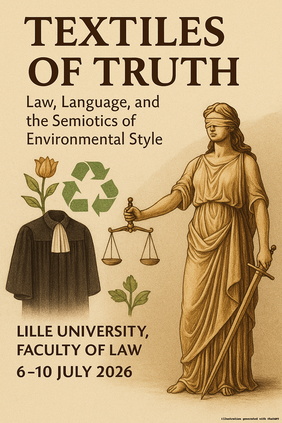
Congrès : "26th International Roundtable for the Semiotics of Law (IRSL)"
Equipe Demogue Colloque CongrèsINTERNATIONAL CONGRESS
Call for Papers
26th International Roundtable for the Semiotics of Law (IRSL)
Theme: “Textiles of Truth: Law, Language, and the Semiotics of Environmental Style”
Lille University, Faculty of Law
6 -10 July 2026
In an age where environmental degradation, climate change, and hyper-consumerism converge with fast-paced global trade and digital communication, the language of law must evolve to meet new ethical, ecological, and cultural challenges. From courtroom rulings to eco-labels, from fast fashion to forest protection, how we speak, legislate, and translate ideas of sustainability and responsibility is not neutral—it is deeply semiotic, symbolic, and political.
This roundtable invites critical and creative engagements with the legal, linguistic, and visual forms of communication that shape contemporary discourses around environmental justice and consumer responsibility. We are particularly interested in how climate change reshapes the legal imagination, calling for the protection of animals, the preservation of biodiversity, and a rethinking of legal obligations in the face of ecological collapse.
The fashion and textile industries serve as prime sites for exploring these dynamics. Whether critiquing the impact of fast fashion, tracing the rise of “upfashion”, or investigating upcycling as a semiotic and legal gesture of resistance, contributors are encouraged to unpack how style, law, and communication are entangled in the ethics of our material world.
IRSL 2026 Conference –Program
Online Conference (France – CET/CEST)
|
| Monday, 6 July 2026 Foundations: Semiotics, Language & Legal Meaning |
| 08h50 | The Linguistic Turn in Environmental Law in Hong Kong |
| 09h10 | Strategic Impoliteness and Media Reception in the Climate Discourse of Greta Thunberg |
| 09h30 | Discussion |
|
| Greenwashing, Labels & Consumer Law |
| 09h50 | The Semiotics of Environmental Claims: Certification, Communication, and the Regulation of Greenwashing in EU Law Maciej Nyka and Justyna Przedańska, University of Gdańsk, Faculty of Law and Administration – Poland. Dr hab Maciej Nyka, Professor of the University of Gdansk, Professor of the Gdansk Medical University. Head of the Economic Law and Environmental Department at the Faculty of Law and Administration, at the University of Gdansk. Author of over 100 articles books and chapters on environmental protection law. His research concentrates mostly on international and EU environmental law. Currently working on numerous projects concerning the functioning and implementation of the One Health concept into the law |
| 10h10 | From Eco-Labels to Liability: Consumer Litigation as a Proxy for Environmental Accountability |
| 10h30 | Between Truth and Simulation: Legal Semiotics of the Right to Memory Mirosław Michał Sadowski LLD, University of Strathclyde, Glasgow, United Kingdom |
| 10h50 | The Linguistic Construction of Consumer Protection in Vietnamese Law: a Systemic Functional Approach |
| 11h10 | Discussion & Pause |
|
| Digital & Algorithmic Semiotics |
| 11h40 | L’asymétrie sémiotique algorithmique: le traitement automatique du langage face aux défis interprétatifs du droit de la consommation Ahmad Ichrakieh and May Hammoud, Kuwait International Law School, Koweït. Dr. May Hammoud holds a PhD in Law from Paris II Panthéon-Assas University. Her research focuses on consumer protection in comparative Lebanese and French law, particularly in insurance and banking contracts. She is currently Associate Professor of Law at Kuwait International Law School. Her research interests include comparative private law, consumer protection, digital regulation, and the legal challenges of artificial intelligence and algorithmic interpretation. |
| 12h10 | Algorithmic Labelling and the Transformation of Trust in Digital Environmental Governance Murtaza Mohiqi, Department of Law, University of Agder, Norway; Gagandeep Kaur, UPES, Dehradun, India and Mohammad Kazem Mohaqei, Human Rights Activitist. |
| 12h30 | Digital product passports and design IP: exploring approaches to tracking ownership in circular fashion Eleanor Rockett, UK. |
| 12h50 | Discussion |
| 13h10 | End of the Day 1 |
|
| Tuesday 7th July 2026 Interpretation, Signs & Market Regulation |
| 09h00 | From Legalese to Practice: The ICC Code of Advertising and Marketing Communications as a Semiotic Bridge in Teaching Advertising and Consumer Law to Marketing Students Yuliya Khvatsik, Jönköping international business school (JIBS), Jönköping University JU, Sweden. |
| 09h20 | Walls of Shame as Retail Environmental Style: Contextual Privacy and the Semiotics of Truth-Claims in New York Chinatown Supermarkets Alex Chanhou Lou, DLI Researcher at Cornell University, Macau Fellow Researcher at the University of Macau, Macau. |
| 09h40 | Discussion & Pause |
|
| Greenwashing, Labels & Consumer Law |
| 10h10 | Eco-labels as Legal Signs: Interpreting Greenwashing through the Semiotics of Consumer Law Nguyen Thi Kim Ngam, University of Law, Vietnam University, Hanoi, Vietnam. |
| 10h30 | Weaving Ecocide into Legal Discourse: The Semiotics of Environmental Harm and the Struggle for Recognition Dr Veljko Turanjanin, Associate Professor, Faculty of Law, University of Kragujevac – Serbia. |
| 10h50 | Discussion |
| 11h10 | End of the Day 2 session |
|
| Wednesday 8th July 2026 Fashion Law & Sustainability |
| 08h30 | Adverse Impacts of the Fashion Industry – Focus on the Emerging Regulatory Options Eva Balounová. Institute of State and Law of the Czech Academy of Sciences, Czech Republic. |
| 08h50 | The Dark Pattern of Ultra-Fast Fashion: Case Study of Shein Kata Zsófia Prém, University of Miskolc, Ferenc Deák and Emese Dobos, ELTE Centre for Economic and Regional Studies, Hungary. Emese Dobos, PhD, is a Research Fellow in the ELTE Center for Economic and Regional Studies. She has a background in art history, communication, media and international studies. Her main research interests are the global fashion value chains, sustainability, and lately, the economic history of the socialist light industry. |
| 09h10 | Weaving Responsibility: The Semiotics of Sustainability in Global Fashion Law Shuma Talukdar, School of Law, Mahindra University, Hyderabad – India. |
| 09h30 | Discussion & pause |
|
| ESG, Greenwashing & Corporate Narratives |
| 10h10 | When Law Becomes Label: ESG Reporting, Greenwashing, and the Semiotic Denaturing of Environmental Governance in the Fashion Industry Dana Volosevici, Petroleum-Gas University of Ploiești, Romania. |
| 10h30 | Textiles of Truth or Textiles of Talk? Eco-Labels, Greenwashing, and the Legal Meaning of “Sustainable Fashion” Obbie Afri, Faculty of Law, Károli Gáspár University, Budapest, Hungary. |
| 10h50 | From Logo to Loop: Upcycling, Circular Fashion, and the Semiotics of Trademark Interpretation Yana Shipha Topno, University - National University of Study and Research in Law, Ranchi, Jharkhand, India. Yana Shipha Topno, a 5th year law student in National University of Study and Research in Law, with academic interests in Intellectual Property Law. The current paper explores issues relating to trademark law and circular fashion practices, particularly the legal implications of upcycled products containing recognizable brand identifiers. I am particularly interested in interdisciplinary approaches to contemporary legal challenges and emerging developments in legal scholarship |
| 11h10 | Discussion |
| 11h30 | End of the Day 3 session |
|
| Thursday, 9 July 2026 Identity, Power & Legal Symbolism |
|
| Law, Clothing & Authority |
| 08h30 | Judicial Robe as a Universal Textile of Justice Prof. Dr. Marko Novak, European Faculty of Law, New University, Department of Legal Theory and History of Law, Ljubljana, Slovenia. |
| 08h50 | Who Gets the Robe? Circular Responsibility and the Semiotics of Legal Authority in Postcolonial Vietnam Dr. Cuong Viet Do, University of Law, Vietnam National University, Hanoi, & Mr. Dinh Cong Nguyen, Communication Specialist. |
| 09h10 | The “Fabric” of Law in Contemporary India: Legal Dress, Colonial Continuities, and Sustainable Future Digvijay Singh Rana - O. P. Jindal Global University, India. |
| 09h30 | Discussion & Pause |
|
| Culture, Ritual & Authenticity |
| 10h00 | Governing Attributes: Ritual Clothing, Performative Life Laws, and Contestation of Authenticity in Bali Tourism Dewa Krisna Prasada, Faculty of Law, Universitas Pendidikan Nasional, Indonesia |
| 10h20 | Weaving ESG Narratives: Visual Jurisprudence, Indigenous Textiles, and Environmental Style in Latin America Carolina Fabara, Post Doctoral Researcher Sun Yat Sen University, China. Dr. Carolina Fabara is an Ecuadorian international lawyer, accredited mediator, and postdoctoral fellow at Sun Yat-sen University, where her research bridges international economic law, foreign direct investment, digital governance, and sustainable development. With a PhD in International Law earned through studies in China and Ecuador, she has built a distinguished career at the crossroads of legal academia, arbitration practice, and cross-border consulting — with a particular focus on China–Latin America economic relations. At the frontier of legal innovation, Dr. Fabara investigates how artificial intelligence is transforming dispute resolution and judicial systems, with a focus on China's internet courts, AI-powered e-commerce arbitration, and the governance of algorithmic justice. Her research interrogates the procedural legitimacy of AI-driven adjudication, the evidentiary challenges of machine-learning systems in online courts, and the power asymmetries that AI tools create between China, the EU, and Latin America. She also explores predictive justice through interdisciplinary lenses — including Confucian philosophy and Marxist critique — examining how cultural narratives shape the normative imagination of algorithmic governance. Her work on AI in banking and financial services further addresses algorithmic bias, consumer protection, and accountability in automated decision-making systems |
| 10h40 | Discussion |
| 11h00 | End of the Day 2 session |